.png)
Katha Upanishad — Story, Translation & Life Lessons

Updated: Sep 29
"What is the truth that remains when the body is gone?"
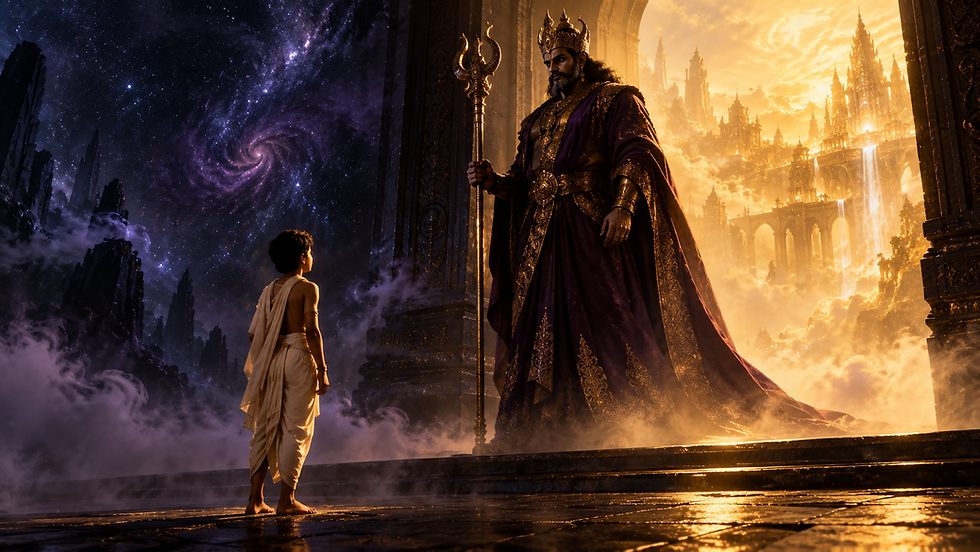
This is the question that drives the Katha Upanishad, one of the most poignant and dramatic texts in the Mukhya (primary) Upanishads. Unlike many other philosophical texts that read like dry treatises, the Katha Upanishad unfolds as a dialogue—a daring encounter between a mortal boy and the God of Death. It is a bridge between the fear of ending and the discovery of an eternal beginning.
The text is embedded within the Krishna Yajurveda, but its influence spans across all schools of Indian philosophy. It transforms the abstract concept of Moksha (liberation) into a practical quest, teaching us that the secret to immortality is not found in avoiding death, but in understanding the nature of the Self.
The Story of Nachiketa: A Journey into the Unknown
The narrative begins with a young boy named Nachiketa. His father, a priest, had become negligent in his sacrificial duties, giving away cows that were old and useless. Noticing this hypocrisy, Nachiketa asked his father why he would offer gifts that brought no joy to the receiver. Offended by the boy's insight, the father cursed him, saying, "Go to Death!"
Driven by an innocent but fierce determination, Nachiketa traveled to the abode of Yama, the Lord of Death. Yama was not home upon his arrival, and for three days, Nachiketa waited at the gates without food or water. When Yama finally returned, he was moved by the boy's austerity and patience. To compensate for the hospitality he failed to provide, Yama offered Nachiketa three boons.

The Three Boons
Nachiketa’s requests reveal the evolution of a seeker's mind, moving from the familial to the metaphysical:
1. The First Boon: He asked for the restoration of his father's peace of mind and the reconciliation of their relationship.
2. The Second Boon: He sought to know how the world functions—how the soul journeys after death and whether it survives the physical body.
3. The Third Boon: He asked the ultimate question: "What happens after death? Is there a soul or is there not?"
Yama, amused and impressed, agreed. He explained that while the senses are fleeting, the Atman (the individual soul) is eternal. This led to the core philosophical discourse of the text.
Yama’s Temptation and the Quest for Reality
Before revealing the secret of the Atman, Yama tested Nachiketa. He offered him worldly riches: immense wealth, long life, celestial maidens, and power. He promised that Nachiketa would be the most
powerful ruler on Earth influential man to ever live. Nachiketa, however, remained unmoved. He recognized that these treasures were Anitya (impermanent) and would eventually fade. He told Yama that even the gods perish, and therefore, only the knowledge of the eternal could satisfy him. This resolve proved that Nachiketa was not seeking a comfortable life, but a liberated one
powerful ruler on Earth. Nachiketa, however, remained unmoved. He recognized that these treasures were Anitya (impermanent) and would eventually fade. He told Yama that even the gods perish, and therefore, only the knowledge of the eternal could satisfy him. This resolve proved that Nachiketa was not seeking a comfortable life, but a liberated one.
The Core Teachings: Shreyas versus Preyas
Having passed the test, Nachiketa was introduced to one of the most practical distinctions in Vedanta: the difference between Shreyas (the good/beneficial) and Preyas (the pleasant).
Yama explains that every human is faced with this choice daily. Preyas is the path of immediate gratification—the impulse to do what feels good in the moment. Shreyas is the path of long-term spiritual growth—the choice that is beneficial for the soul, even if it requires discipline. Yama warns that those who follow Preyas are trapped in a cycle of endless desire, while those who choose Shreyas find lasting peace and liberation.
The Nature of the Self (Atman)
Yama reveals that the Atman (the inner Self) is never born and never dies. It is Ajanma (unborn) and Anamanta (undying). The physical body is merely a garment that the soul wears for a time.
The goal of human life is to realize this eternal nature. When a person identifies with the body, they suffer from the fear of death. When they identify as the Atman, they realize they are one with the universal consciousness, Brahman (the ultimate reality). This shift in identity is the essence of spiritual awakening.

The Parable of the Chariot
To explain how the human psyche works, the Katha Upanishad uses the powerful analogy of the chariot:
● The Chariot: Represents the physical body.
● The Horses: Represent the five senses (Indriyas), which are wild and impulsive.
● The Reins: Represent the mind (Manas), which controls the senses.
● The Charioteer: Represents the intellect (Buddhi), which directs the path.
● The Passenger: Represents the Atman (the Soul), who sits silently within.
Yama teaches that if the charioteer (intellect) is weak and the reins (mind) are loose, the horses (senses) will pull the chariot off the road. Only through Samyama (self-control) can the intellect guide the senses toward the destination of liberation.
The City of Eleven Gates and the Tree of Eternity
The text describes the human body as a "City of Eleven Gates"—referring to the nine openings of the head and body plus the mind and intellect. These gates allow the external world to enter and the internal energy to leak out.
In the center of this city stands the Akshaya Vat (the Tree of Eternity). Its roots are in the depths of the heart, and its branches reach toward the heavens. This tree bears the fruits of desire, action, and knowledge. By meditating on the root of this tree—the silent witness within—the seeker transcends the noise of the eleven gates.

The Path of Yoga: "The Razor's Edge"
The Katha Upanishad describes the path to realization as Kshurasya Dhara—the edge of a razor. This means that the margin for error is slim; it requires absolute precision, unwavering focus, and total sincerity.
Yama explains that yoga is the steadying of the senses. When the senses are withdrawn and the mind is stilled, the seeker can perceive the Atman residing in the heart, wrapped in the layers of the ego. To see the Self, one must be "determined, focused, and clear."
Life Lessons for the Modern Seeker
The dialogue between Nachiketa and Yama is not merely an ancient story; it is a roadmap for modern existence:
1. Question Everything: Like Nachiketa, we must have the courage to ask the "big questions" about life and death.
2 .Seek the Eternal over the Temporary: In an era of instant gratification, the distinction between Shreyas and Preyas is more relevant than ever. Choosing what is "good" over what is "pleasant" allows us to build a life of meaning rather than a life of momentary pleasure.
3. Accept Impermanence: By understanding that the physical body is a garment and the Atman is eternal, we can face loss and aging with grace and equanimity.
4. Master the Senses: The Parable of the Chariot reminds us that we are not our impulses. By strengthening our Buddhi (intellect), we stop being passengers to our moods and become masters of our destiny.
The Great Beyond
The climax of the Katha Upanishad is the realization that death is not an end, but a transition. Yama explains that the soul is not killed, nor does it kill. It is the eternal witness that moves from one state of existence to another, driven by the Karmas (actions) it has performed. When the seeker finally realizes the unity of the individual soul and the universal spirit, the cycle of birth and death—Samsara—comes to an end. Nachiketa returns to the world of the living, not as a boy who feared his father's negligence, but as a realized soul who knows the secret of immortality.

Quick Comparison: Preyas vs. Shreyas
Feature | Preyas (The Pleasant) | Shreyas (The Good) |
Primary Motivation | Immediate gratification | Long-term growth |
Experience | Temporary pleasure, eventual void | Lasting peace, spiritual fulfillment |
Outcome | Continued cycle of desire (Samsara) | Path toward liberation (Moksha) |
Analogy | Eating candy for a quick sugar rush | Exercising for lifelong health |
Frequently Asked Questions about Katha Upanishad
1. Who is Nachiketa in the Katha Upanishad?
Nachiketa is a young, inquisitive student who, after being sent to the god of death (Yama) by his father, seeks the ultimate knowledge of what happens after death.
2. What is the difference between Atman and Brahman?
Atman is the individual soul or the innermost essence of a person, while Brahman is the universal, infinite reality. The Katha Upanishad teaches that these two are ultimately one.
3. What does "The Razor's Edge" mean in this context?
It refers to the extreme precision and discipline required in spiritual practice;
to avoid falling back into ignorance or spiritual complacency.
4. What is the main lesson of the Katha Upanishad?
The central lesson is the distinction between the transient and the eternal, urging the seeker to prioritize spiritual wisdom (Jnana) over worldly pleasures to achieve liberation from the cycle of rebirth.
5. How does the Parable of the Chariot relate to mental health?
It teaches that mental stability comes from the Buddhi (intellect) guiding the Manas (mind) and Indriyas (senses). When we allow our impulses to lead, we experience chaos; when we lead with intellect, we find peace.
6. Is the Katha Upanishad a religious text or a philosophical one?
While rooted in the Vedic tradition, it is primarily a philosophical inquiry into the nature of existence, consciousness, and the soul, making its lessons universal regardless of one's faith.
Key Takeaways: The Essence of the Katha Upanishad
● Discernment is Power: The ability to choose Shreyas (the good) over Preyas (the pleasant) is the first step toward spiritual maturity.
● The Self is Eternal: The Atman is never born and never dies; it is the unchanging witness within the changing body.
● Discipline is Required: Realization is not an accident but the result of a "razor's edge" level of focus and sensory control.
● Death is a Gateway: By understanding the nature of the soul, death ceases to be a terror and becomes a transition.


Comments